
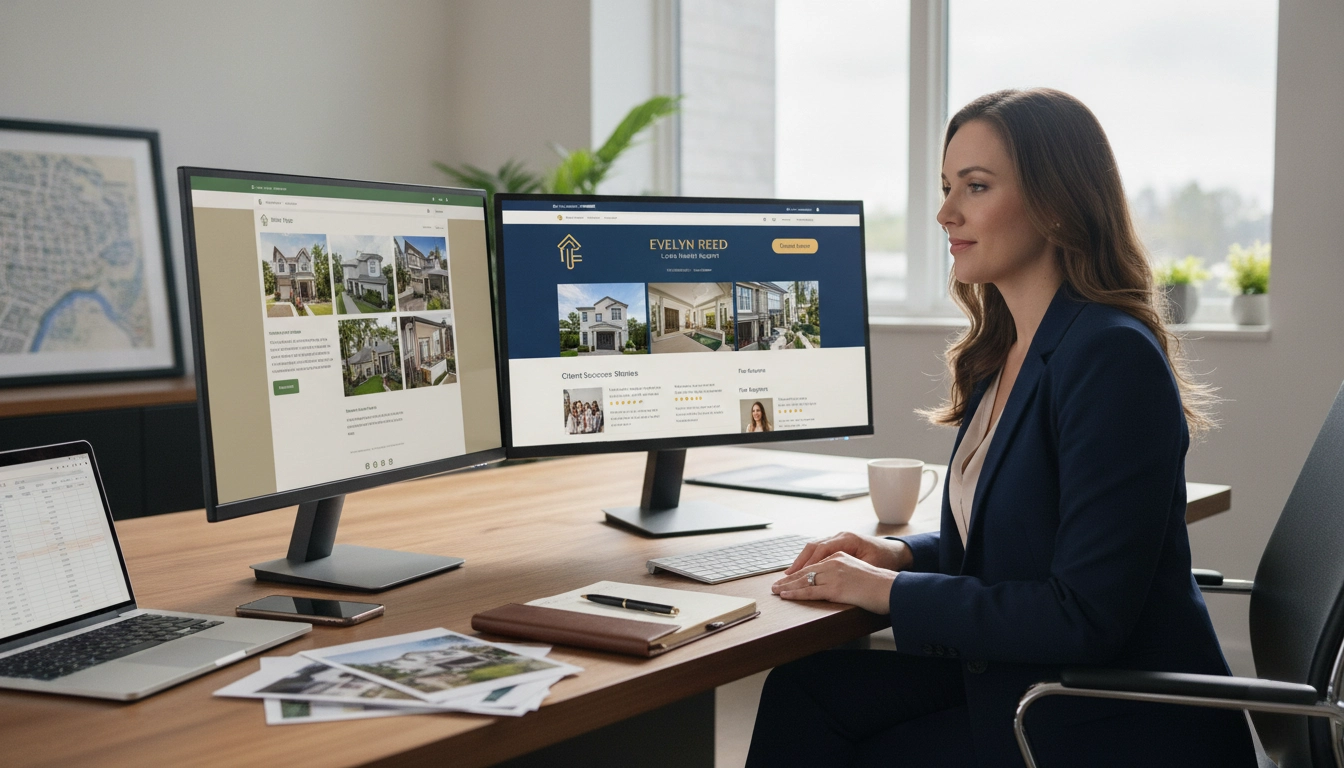
Most strong agents are not struggling because they lack skill.
They know their market.
They take care of clients.
They communicate well.
They negotiate.
They solve problems.
They get referrals.
They deliver a strong client experience.
But online, they may not look that way.
Their website feels outdated.
Their Google presence is thin.
Their reviews are hard to find.
Their branding feels scattered.
Their brokerage profile does not tell the full story.
Their online presence does not match the quality of their real-world service.
That creates a gap.
A client may hear your name from a referral, Google you, and think, “Is this the right agent?”
A seller may compare you with another Realtor and quietly feel like the other agent looks more established.
A buyer may land on your website and not understand what makes you different.
An AI search tool may not have enough clear information to understand who you are, where you work, or why you are credible.
That is the problem.
Looking premium online is not about ego.
It is not about pretending to be bigger than you are.
It is about making your online presence match the quality of the agent you already are.
When that changes, the entire perception of your business changes.
Before: You Look Like Every Other Agent
Before an online presence upgrade, many agents look generic.
Their website uses the same phrases everyone else uses:
“Helping buyers and sellers achieve their dreams.”
“Your trusted real estate professional.”
“Dedicated to exceptional service.”
“Making real estate simple.”
Those lines are not terrible.
They are just forgettable.
A seller visiting the site does not immediately understand:
- Who the agent helps
- What market they specialize in
- What kind of clients they work with
- Why they are credible
- What makes their process different
- Why a referral recommended them
- Why they should call this agent instead of another one
That is what makes a generic online presence dangerous.
It does not offend anyone.
It just fails to create confidence.
The agent may be excellent in person, but online they look interchangeable.
That is a problem because sellers and buyers compare agents before ever reaching out.
If your website, Google profile, and brand look like everyone else’s, you become easier to replace.
For more on this issue, read: What Every Realtor Website Needs in 2026
After: Your Brand Feels Clear, Specific, and Memorable
After a premium online upgrade, your brand starts to feel intentional.
Instead of sounding like every agent, your online presence answers the most important questions quickly:
- Who are you?
- Where do you work?
- Who do you help?
- What kind of real estate do you focus on?
- Why do clients trust you?
- What is the next step?
Your homepage might shift from:
“Helping buyers and sellers with all their real estate needs.”
To something like:
“Helping Brentwood homeowners prepare, price, and sell with confidence.”
Or:
“Guiding relocating families through the Charlotte real estate market.”
Or:
“A listing-focused Realtor helping Scottsdale sellers move with a clear strategy.”
That change matters.
Specificity creates trust.
A premium online presence makes it easier for the right client to understand why you are the right fit.
You are no longer just “a Realtor.”
You become a clear choice for a specific market, client type, or service.
That is differentiation.
Before: Your Website Looks Nice but Does Not Build Trust
Some agents already have websites that look decent.
The colors are clean.
The layout is modern.
The photos are professional.
The site does not look broken.
But it still does not convert.
Why?
Because pretty design is not the same as credibility.
A website can look nice and still fail if it does not answer the client’s real concerns.
A seller wants to know:
- Do you understand my market?
- Do you have a listing process?
- Do you have strong reviews?
- Do you know how to position my home?
- Do you communicate clearly?
- Do you look like someone I can trust with a major financial decision?
A buyer wants to know:
- Do you understand the neighborhoods I care about?
- Can you guide me through the process?
- Will you help me make smart decisions?
- Are you responsive?
- Do you know this market well?
A referral wants to know:
- Does this recommendation make sense?
- Is this agent credible?
- Should I call them?
If your website only looks good but does not answer those questions, it is not doing enough.
Design is the surface.
Trust is the substance.
After: Your Website Confirms the Referral
After the upgrade, your website has a job.
It confirms the referral.
When someone hears your name and looks you up, the website reinforces what they were told.
It makes them think:
“This agent looks professional.”
“This recommendation makes sense.”
“They work in my market.”
“They have proof.”
“They seem like someone I should contact.”
That is the moment your website should be built for.
A premium Realtor website does not just show your logo and listings.
It guides the visitor through trust.
It usually includes:
- Clear homepage positioning
- Strong about page
- Buyer and seller pages
- Visible reviews
- Local expertise
- Professional branding
- Clear calls to action
- Mobile-friendly design
- Consistent contact information
- Strong Google presence connection
The referral gets you considered.
Your website helps you get called.
For more on this core message, read: Why Your Brokerage Website Is Not Enough Anymore
Before: Sellers Are Not Sure Why You Are Different
Before an online presence upgrade, sellers may like you but still struggle to understand why you are different.
Your website may not explain your listing process.
Your reviews may not be easy to find.
Your seller page may be thin or missing.
Your local content may be vague.
Your brand may not show the level of service you actually provide.
That can make you look like a commodity.
And when sellers see agents as commodities, they compare based on things like:
- Who has the flashiest listing presentation
- Who has more reviews
- Who looks more premium online
- Who seems more visible
- Who has the lower commission
- Who feels safer based on first impression
That is not where a strong agent wants to compete.
You do not want to be chosen because you looked similar but cheaper.
You want sellers to understand your value before the first conversation.
Your online presence should help position you as a credible, prepared, thoughtful professional.
After: Sellers See a Clear Listing Strategy
After the upgrade, your website speaks directly to sellers.
It does not just say, “I can help you sell your home.”
It shows that you have a process.
A strong seller page may explain:
- How you help sellers prepare
- How you approach pricing
- How you position a listing
- How you market the home
- How you communicate during the process
- How you handle buyer interest
- How you review offers
- How you negotiate
- What sellers can expect
This does not mean giving away your entire listing presentation.
It means giving enough clarity to build confidence.
A premium online presence makes a seller feel like:
“This agent has thought through the process.”
“They know what matters.”
“They look prepared.”
“They understand sellers.”
“They are worth a conversation.”
That is a major perception shift.
You are no longer just asking sellers to trust you.
You are showing them why they can.
Before: Your Reviews Exist, but They Do Not Work Hard Enough
Many agents have happy clients.
But their reviews are scattered, hidden, or underused.
Some are on Google.
Some are on Zillow.
Some are buried on a brokerage profile.
Some are sitting in text messages or emails.
Some are not visible anywhere.
Even when reviews exist, they may not be placed where they help conversion.
For example, a seller page without seller testimonials is weaker than it should be.
A homepage without review proof may not build trust fast enough.
An about page without social proof may feel incomplete.
A premium brand does not hide proof.
It organizes proof.
Before the upgrade, the agent’s reputation may be real but hard to see.
That is a missed opportunity.
After: Reviews Become Trust Signals Across the Site
After the upgrade, reviews are placed strategically.
They support the visitor at the right moments.
A strong website may include testimonials on:
- Homepage
- About page
- Seller page
- Buyer page
- Community pages
- Contact page
- Reviews page
The best reviews are specific.
A weak review says:
“Great agent. Highly recommend.”
That is helpful, but limited.
A stronger review says:
“She helped us sell our home in Brentwood. She explained pricing clearly, helped us prepare the house, managed multiple offers, and kept us informed through every step.”
That review builds trust because it includes:
- Location
- Service type
- Client experience
- Process
- Communication
- Confidence
Specific proof makes your premium positioning believable.
It helps the visitor feel like other people have already trusted you and had a strong experience.
Your reviews are not just decoration.
They are part of your credibility system.
Before: Your Google Presence Feels Thin
A weak Google presence can make a strong agent look less established.
When someone searches your name, they may see:
- No clear personal website
- Incomplete Google Business Profile
- Few reviews
- Old photos
- Outdated brokerage information
- Weak profile descriptions
- Inconsistent phone numbers
- Random directory results
- Social profiles with no clear brand
- A brokerage page that looks like every other agent
That creates uncertainty.
The person may not think deeply about it. They may not say, “This agent has poor Google presence.”
They may just feel less confident.
That matters because Google is often the first place people go after receiving a referral.
If what they find looks thin, outdated, or scattered, the referral loses strength.
After: Your Name Search Feels Credible
After a premium online upgrade, your Google presence feels more complete.
When someone searches your name, they are more likely to see a connected, credible online footprint.
That may include:
- Personal website
- Complete Google Business Profile
- Strong reviews
- Updated photos
- Consistent contact information
- Brokerage profile
- Zillow profile
- Realtor.com profile
- Social profiles
- Local content
- Clear brand messaging
The goal is not to control every search result.
No agent can fully control that.
The goal is to make the overall impression stronger.
When a referred prospect searches you, the pieces should align.
Your website, Google profile, reviews, and other profiles should tell the same story.
That story should be:
“This agent is credible, active, local, professional, and easy to trust.”
For more on this, read: Local SEO for Real Estate Agents and AI Referrals
Before: Your Online Presence Is Scattered
A scattered online presence creates friction.
Your website says one thing.
Your Google profile says another.
Your Zillow profile has an old bio.
Your brokerage profile has an outdated photo.
Your social media links are inconsistent.
Your contact information varies across platforms.
Your digital business card does not match your brand.
None of these issues may seem huge on their own.
Together, they create doubt.
A client may wonder:
- Is this agent active?
- Is this information current?
- Which profile is the real one?
- Why does everything feel disconnected?
- Is this agent professional online?
A premium online presence feels cohesive.
That cohesion builds trust.
After: Your Brand Feels Connected Everywhere
After the upgrade, your online assets work together.
Your website, Google Business Profile, Zillow profile, brokerage profile, social media, email signature, and digital business card all feel connected.
They use consistent:
- Name
- Headshot
- Contact information
- Website link
- Service areas
- Bio
- Brand message
- Visual style
- Calls to action
This does not mean every platform looks identical.
It means the impression is consistent.
A prospect should feel like they are seeing one professional brand, not a collection of disconnected profiles.
That consistency matters because trust is built through repetition.
The more aligned your online presence feels, the more established you look.
Before: Your Brokerage Profile Carries Too Much Weight
A brokerage profile is useful.
It can show your affiliation, listings, contact information, and basic bio.
But it should not carry your entire online brand.
Before the upgrade, many agents rely too heavily on their brokerage profile because they do not have a strong personal website.
That creates limitations.
A brokerage profile usually gives you limited control over:
- Brand messaging
- Page design
- Calls to action
- Local content
- SEO structure
- Testimonials
- Service pages
- Lead capture
- Long-term ownership
- AI visibility support
A brokerage profile may prove you exist.
It rarely proves why someone should choose you.
That is why agents need an owned online presence.
After: Your Personal Website Becomes the Credibility Hub
After the upgrade, your personal website becomes the center of your online presence.
Your brokerage profile still matters. Zillow still matters. Google still matters. Social media still matters.
But your website leads.
It gives you ownership and control.
You can shape:
- Your message
- Your pages
- Your content
- Your calls to action
- Your local authority
- Your reviews
- Your visual brand
- Your lead capture
- Your long-term digital equity
Your personal website becomes the place where clients can understand the full version of your brand.
For more on ownership, read: Personal Website vs Brokerage Profile
Before: AI and Search Tools Have Limited Context
AI search is becoming another layer of online research.
A prospect may ask ChatGPT, Gemini, Perplexity, Google AI, or another tool questions like:
- “Who are the best Realtors in [City]?”
- “What can you tell me about [Agent Name]?”
- “Is [Agent Name] a good Realtor?”
- “Which agents have strong reviews near me?”
- “Who specializes in selling homes in [Neighborhood]?”
No one can guarantee that AI tools will recommend a specific agent.
But AI tools need clear, accessible online information to understand who you are.
Before the upgrade, your online presence may not give enough context.
That may happen if:
- Your website is thin
- Your service areas are vague
- Your reviews are hard to find
- Your profiles are inconsistent
- Your seller expertise is not documented
- Your local content is missing
- Your Google profile is incomplete
That does not help people, Google, or AI understand your credibility.
After: Your Online Presence Gives Search and AI More to Understand
After the upgrade, your online presence becomes clearer.
Your website explains:
- Your name
- Your market
- Your services
- Your client focus
- Your local expertise
- Your reviews
- Your professional background
- Your calls to action
This supports your broader visibility.
It does not guarantee rankings or AI recommendations.
But it makes your online identity easier to understand.
That matters because search is changing.
People are not only typing keywords into Google. They are asking more direct questions. They are researching agents across search engines, AI tools, review platforms, social media, and personal websites.
A premium online presence gives them a clearer answer.
For more on this, read: The Realtor’s Guide to Getting Found in AI Search
Before: You May Be Losing Opportunities Silently
The hardest part about a weak online presence is that you often do not know what it costs you.
A seller may research you and choose another agent.
A referral may look you up and never call.
A buyer may compare your website with another agent’s and choose the one who looks more established.
You may never hear about it.
They usually will not say:
“Your website made me hesitate.”
“Your Google profile did not give me enough confidence.”
“Your reviews were hard to find.”
“The other agent looked more premium online.”
They just move on.
That is why online presence is not just a marketing issue.
It is a trust issue.
After: You Remove Unnecessary Doubt
A premium online presence does not guarantee that every prospect will choose you.
But it can reduce avoidable doubt.
That is the transformation.
Before, your online presence may have made people hesitate.
After, it helps them feel more confident.
Before, your website may have looked like a placeholder.
After, it works like a credibility hub.
Before, your reviews may have been scattered.
After, they support trust across your site.
Before, your brand may have felt generic.
After, it feels specific and professional.
Before, your Google presence may have looked thin.
After, it feels more complete.
Before, your online presence may have undersold you.
After, it starts matching your real-world reputation.
That is the point.
You do not need to pretend to be something you are not.
You need your online presence to reflect the quality you already deliver.
What “Premium Online” Actually Means
Looking premium online does not mean looking flashy.
It does not mean using luxury colors, dramatic copy, or expensive-looking visuals without substance.
Premium means credible.
Premium means clear.
Premium means intentional.
A premium online presence should feel:
- Professional
- Specific
- Trustworthy
- Local
- Consistent
- Easy to navigate
- Proof-driven
- Client-focused
- Current
- Aligned with your real service level
It should show that you take your business seriously.
It should make a client feel like they are dealing with a real professional, not a generic profile.
Premium is not about pretending.
It is about reducing doubt.
Premium Online Presence Checklist
Use this checklist to evaluate your own online presence.
Website
- Clear homepage message
- Strong about page
- Seller page
- Buyer page
- Local community pages
- Visible testimonials
- Professional design
- Mobile-friendly layout
- Clear calls to action
- Fast loading pages
Brand
- Consistent headshot
- Clear positioning
- Professional visuals
- Strong bio
- Consistent messaging
- Defined service areas
- Client-focused copy
Google Presence
- Complete Google Business Profile
- Accurate contact information
- Strong reviews
- Current photos
- Website link
- Review responses
- Clear service areas
Reviews
- Reviews visible on Google
- Reviews visible on website
- Seller-specific proof
- Buyer-specific proof
- Specific client experiences
- Recent review activity
Profiles
- Updated brokerage profile
- Updated Zillow profile
- Updated Realtor.com profile
- Updated LinkedIn
- Consistent social bios
- Working links
- Matching contact details
Search and AI Clarity
- Your website explains who you are
- Your market is clear
- Your services are clear
- Your reviews are easy to find
- Your local expertise is documented
- Your online profiles align
If several of these are missing, your online presence may not be giving prospects the confidence they need.
FAQ: Looking Premium Online as a Realtor
1. What does it mean for a Realtor to look premium online?
Looking premium online means your website, Google presence, reviews, branding, and profiles make you look credible, professional, current, and trustworthy.
It does not mean looking flashy. It means your online presence matches the quality of service you provide in real life.
2. Can a better online presence help Realtors win more trust?
Yes. A stronger online presence can help buyers, sellers, and referrals feel more confident before contacting an agent.
It can reduce doubt by showing clear positioning, reviews, local expertise, professional branding, and consistent information across platforms.
3. What changes when a Realtor upgrades their website?
A stronger website can improve how prospects perceive the agent.
It can make the agent look more established, explain their services better, show reviews more clearly, support referrals, strengthen Google presence, and create a better first impression before the first call.
4. Is a premium Realtor website only for luxury agents?
No. Every serious agent benefits from a credible, professional online presence.
Premium does not mean luxury-only. It means the website looks trustworthy, clear, and aligned with the agent’s market, client base, and service level.
5. How do Realtors know if their online presence needs an upgrade?
A Realtor may need an upgrade if their website looks outdated, their reviews are hard to find, their Google profile is thin, their branding feels inconsistent, their seller page is weak, or their online presence does not match their real-world reputation.
The Transformation Is Trust
The biggest change when an agent finally looks premium online is not just visual.
It is trust.
Before, prospects may have wondered whether you were the right choice.
After, your online presence helps them feel more confident.
Before, your website may have looked generic.
After, it shows your positioning.
Before, your reviews may have been hidden.
After, they support your credibility.
Before, your Google presence may have been scattered.
After, it feels connected.
Before, you may have looked average online.
After, your online presence starts to match the agent you actually are.
That is the transformation.
Great agents should not look average online.
See What Would Change If You Looked More Premium Online
Not sure whether your online presence reflects the quality of your real estate business?
Book a complimentary Online Presence Audit with LynkMe.
LynkMe reviews your website, Google presence, reviews, branding, AI visibility signals, and overall online credibility so you can see where you look strong, where you look weak, and what needs to be fixed.
Your next referral, seller, or buyer may judge your credibility before ever speaking with you.
Make sure what they find builds trust.