
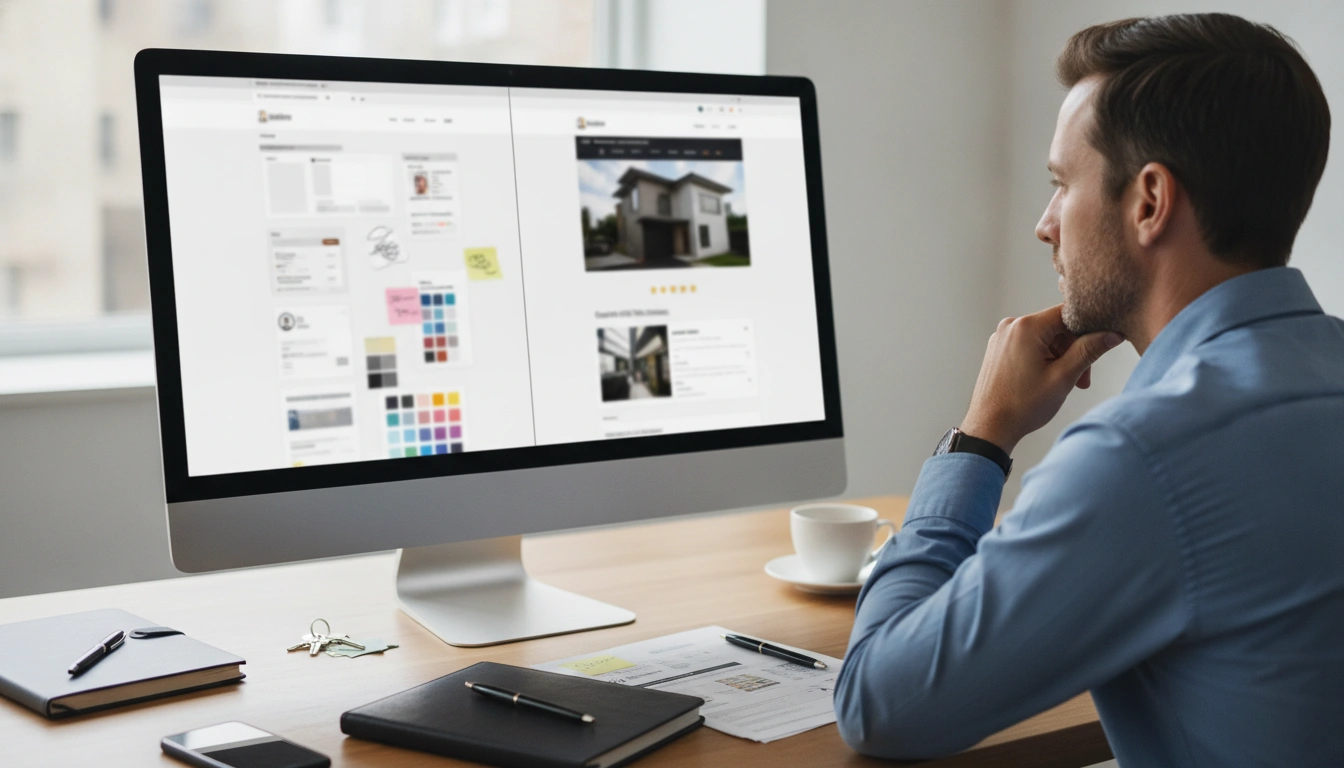
Most agents know their online presence needs work.
The website feels outdated.
The Google profile is thin.
The reviews are not organized.
The bio sounds generic.
The branding does not feel consistent.
The brokerage profile is doing most of the heavy lifting.
And when someone searches the agent’s name, the results do not fully reflect how good that agent actually is.
That is the real problem.
Many agents are better in person than they look online.
They know how to build relationships. They know how to serve clients. They know how to handle listings, negotiations, timelines, emotions, and big decisions.
But online, they may look average.
That gap matters.
Because sellers Google you before they book the listing appointment.
Referrals still research you before they call.
Buyers compare you with other agents.
AI search tools may also use public online signals to understand who you are, where you work, and why you are credible.
So the question is not whether your online presence matters.
It does.
The better question is this:
Should you build it yourself or hire a done-for-you partner to handle it?
DIY can make sense for some agents.
But for serious agents who already have experience, reviews, referrals, and production, a DIY online presence can easily become another unfinished project.
That is what this article breaks down.
The goal is not to convince every agent to hire help.
The goal is to help the right agents understand when DIY is enough, when it starts holding them back, and when a done-for-you online presence becomes the smarter move.
For more on the bigger credibility picture, read: How to Make Your Online Presence Match Your Real-Life Reputation
DIY Online Presence Usually Starts With Good Intentions
Most agents do not ignore their online presence because they do not care.
They ignore it because they are busy.
They are showing homes.
They are preparing listings.
They are following up with leads.
They are negotiating contracts.
They are managing clients.
They are trying to stay visible in their market.
Then, somewhere in the middle of all that, they realize they also need to update their website, clean up their Google Business Profile, request more reviews, write new bio copy, fix their branding, and figure out how to show up better online.
So they try to do it themselves.
They buy a domain.
They choose a website builder.
They pick a template.
They start writing the homepage.
They upload a headshot.
They try to connect a contact form.
They research SEO.
They open their Google profile.
They think about asking past clients for reviews.
Then real estate gets busy again.
The project gets pushed back.
The website stays half-finished.
The Google profile stays incomplete.
The branding still feels scattered.
The agent still knows it needs to be fixed.
That is one of the biggest hidden problems with DIY.
It often starts with motivation, but it stalls because execution takes more time and strategy than expected.
For more on why scattered online presence weakens trust, read: The Online Presence Stack Every Serious Realtor Needs
DIY Can Work for the Right Agent
DIY is not always wrong.
For some agents, it is a practical starting point.
If you are brand new, have a limited budget, and only need a simple placeholder, DIY may be fine.
If you enjoy writing, design, websites, SEO, branding, and technical setup, DIY may be a good fit.
If you have more time than budget, it can make sense to build the basics yourself.
DIY may work if:
- You are early in your real estate career
- You are not ready to invest in a premium brand yet
- You only need a simple temporary website
- You enjoy learning website tools
- You can write your own copy clearly
- You understand basic Google Business Profile setup
- You are comfortable with SEO basics
- You do not mind spending nights or weekends fixing details
- You have the discipline to finish the project
- You are okay with improving it over time
There is nothing wrong with starting simple.
A basic online presence is better than no online presence.
The issue is when an experienced agent keeps using a beginner-level online presence even though their business has moved past that stage.
At some point, your online presence should grow up with your business.
If you are trying to win better listings, convert referrals, look more premium, and build more trust before the first call, the standard needs to be higher.
For more on premium perception, read: Why Some Agents Look Premium Before the First Call Even Happens
The Hidden Cost of DIY Is Not Just Money
DIY looks cheaper on the surface.
A website template may be inexpensive.
A domain may cost very little.
A website builder may look affordable.
But the real cost of DIY is not always the tool.
The real cost is time.
The real cost is delay.
The real cost is uncertainty.
The real cost is weak positioning.
The real cost is a website that technically exists but does not make the agent look more credible.
That matters because your online presence is not just a digital brochure.
It is part of how prospects decide whether you feel trustworthy.
A seller may never say:
“I did not call you because your website looked outdated.”
A referral may never admit:
“I searched your name and was not impressed.”
A buyer may never tell you:
“I compared you with another agent and they looked more established.”
But those impressions still happen.
A weak online presence creates doubt quietly.
And doubt can cost you conversations before you ever know they existed.
For more on this trust gap, read: The Difference Between Looking Busy and Looking Trustworthy Online
Done-For-You Is for Agents Who Need Execution, Not Another Project
Most serious agents do not need another tool.
They need execution.
That is the difference.
A DIY tool gives you software.
A done-for-you online presence gives you strategy, structure, copy, design, setup, and implementation.
A done-for-you partner helps answer the questions most agents do not have time to figure out:
What should my website actually say?
How should I position myself?
What should show up when someone Googles me?
How do I make my reviews more visible?
What pages should my website include?
How do I make sellers trust me before the listing appointment?
How do I make my personal brand stronger than a basic brokerage profile?
How do I give Google and AI tools clearer information about who I am and where I serve?
Those are not small questions.
They affect how prospects see you.
A done-for-you online presence is usually a better fit when the agent already has credibility, but that credibility is not showing up clearly online.
The agent has the experience.
The agent has the clients.
The agent has the proof.
The agent has the reputation.
But the internet does not make that obvious yet.
That is the problem done-for-you should solve.
Your Brokerage Website Is Not Your Personal Brand
Many agents rely too heavily on their brokerage website or agent profile.
That profile may be useful.
But it is not the same as a strong personal brand.
A brokerage profile usually exists inside someone else’s brand. It may have limited customization, limited content, limited SEO value, and limited room to explain your story.
It may show your photo, contact information, license details, and listings.
But it usually does not fully explain why someone should choose you.
A serious personal website should help prospects understand:
- Who you help
- Where you work
- What kind of clients you serve
- What your process looks like
- Why sellers trust you
- What makes your experience valuable
- What proof you have
- What markets you know
- What someone should do next
Your brokerage profile can support your credibility.
But it should not be the whole strategy.
Your website should confirm the referral.
Your Google presence should support your reputation.
Your reviews should provide proof.
Your brand should make you look established.
Your content should help sellers and buyers understand your value.
That is bigger than a brokerage profile.
For more on why referral-based agents still need their own website, read: Why “I Get Most of My Business From Referrals” Is Not a Reason to Ignore Your Website
DIY Often Makes Strong Agents Look Generic
One of the biggest risks of DIY is sounding like every other agent.
Most website templates are not built around your actual story.
They are built to be flexible enough for everyone.
That usually means the copy becomes generic.
A DIY website might say:
“Helping buyers and sellers achieve their real estate goals.”
That is not wrong.
But it does not say much.
It does not tell a seller why you are different.
It does not explain your process.
It does not communicate your market expertise.
It does not show what kind of clients you are best suited to help.
It does not make you look like the obvious choice.
A stronger message might say:
“Helping homeowners in [City] prepare, price, and sell with a clear strategy from listing to closing.”
Or:
“Guiding relocating families through [Market] with local insight, honest advice, and step-by-step support.”
Or:
“A listing-focused Realtor helping move-up sellers in [City] sell with confidence.”
Those messages are more specific.
They help the right prospects understand the agent faster.
That is what good positioning does.
It helps serious prospects self-identify.
It helps them think:
“This agent understands my situation.”
DIY often skips that strategy and jumps straight into picking colors, templates, and fonts.
But design without positioning is not enough.
A Strong Online Presence Is More Than a Website
A lot of agents think they need a better website.
Sometimes they do.
But the website is only one piece.
A strong online presence includes everything a prospect may see when they research you.
That may include:
- Personal website
- Google Business Profile
- Google reviews
- Agent bio
- Brokerage profile
- Zillow profile
- Realtor.com profile
- LinkedIn profile
- Social media pages
- Email signature
- Digital business card
- Local content
- Testimonials
- Search results
- AI visibility signals
- Branding and design consistency
These pieces should work together.
If your website says one thing, your Google profile says another, your bio is outdated, your reviews are hidden, and your social media branding looks different, the overall impression feels scattered.
A serious agent should not look scattered.
A strong agent should look clear, established, and trustworthy.
That is why a done-for-you online presence should not just be a website project.
It should be a credibility system.
For more on the full system, read: The Online Presence Stack Every Serious Realtor Needs
Google Presence Matters Before the First Call
When someone searches your name, your Google presence may be the first thing they see.
That search experience can either build confidence or create doubt.
A strong Google presence may show:
- A complete Google Business Profile
- Strong reviews
- Professional photos
- Clear business information
- Service areas
- Website link
- Current contact information
- Relevant search results
- Consistent profiles
A weak Google presence may show:
- No business profile
- Few reviews
- Outdated information
- Weak photos
- Missing service areas
- Confusing search results
- Inconsistent profiles
- A generic brokerage page instead of your personal brand
This matters because people often make quick judgments.
Especially sellers.
Before they trust you with their home, they want to feel like you are credible.
Your Google presence is part of that first impression.
DIY agents often focus on the website and forget that Google is where the first trust check may happen.
A done-for-you approach should look at both.
Your website should deepen trust.
Your Google presence should create confidence at the search level.
For more on this, read: Google Business Profile for Realtors: Why It Is Your First Impression
Reviews Are Too Important to Leave Scattered
Reviews are one of the strongest credibility signals an agent has.
But many agents do not use them well.
They may have reviews on Zillow.
A few on Google.
Some in text messages.
Some in emails.
Some in old social posts.
Some in listing presentations.
But they are not organized into a clear online proof system.
That is a missed opportunity.
Reviews should help prospects feel safer before they call.
They should appear where trust decisions happen:
- Google Business Profile
- Website homepage
- About page
- Seller page
- Buyer page
- Reviews page
- Follow-up emails
- Listing materials
- Digital business card
A review that is hidden does not help enough.
A review that is visible at the right moment can support trust.
This is especially important for referral-based agents.
A referred prospect may already trust the person who gave them your name.
But they still want proof that you are the right fit.
Your reviews help confirm that.
For more on review strategy, read: Why Google Reviews Matter for Real Estate Agents
AI Visibility Is Another Reason DIY Needs Strategy
AI search is becoming another layer of discovery.
People may ask tools like ChatGPT, Gemini, Perplexity, or Google AI questions such as:
“Who are trusted Realtors in [City]?”
“What can you tell me about [Agent Name]?”
“Who specializes in selling homes in [Market]?”
“Who are good listing agents near me?”
“Which agents have strong reviews in [City]?”
No one can guarantee that AI tools will recommend a specific agent.
That should be clear.
But AI tools may use public online information to understand who you are, where you serve, and whether your online presence shows credibility.
If your website is thin, your reviews are limited, your profiles are inconsistent, and your local content is weak, there may not be enough clear information for AI or search tools to understand your relevance.
That is why AI visibility is not about tricks.
It is about clarity.
A stronger online presence can make your credibility easier to find and understand.
This may include:
- Clear website content
- Strong About page
- Local service pages
- Community content
- Google reviews
- Consistent profiles
- Accurate business information
- Clear service areas
- Credibility signals
- Structured messaging
DIY can miss this because many agents think only about how the website looks.
But AI and search visibility depend more on what the internet can understand about you.
For more on this topic, read: AI Visibility for Realtors
Done-For-You Helps Agents Look More Premium
Premium does not mean flashy.
It means intentional.
A premium online presence feels clear, professional, current, and aligned with the level of service the agent provides.
That can include:
- Strong homepage messaging
- Professional visual direction
- Clear seller and buyer pages
- Visible reviews
- Updated headshots
- Consistent brand colors
- Clean typography
- Better calls to action
- Local credibility content
- Strong About page
- Google profile alignment
- Mobile-friendly design
This matters because sellers notice presentation.
They may not describe it in marketing terms.
But they notice whether you look current.
They notice whether your website feels professional.
They notice whether your reviews are visible.
They notice whether your brand feels consistent.
They notice whether you look like someone who takes details seriously.
That affects perceived value.
If you are asking a seller to trust you with the presentation of their home, your own presentation matters too.
For more on premium branding, read: Why Some Agents Look Premium Before the First Call Even Happens
DIY vs Done-For-You: The Practical Difference
Here is the simple breakdown.
DIY gives you control.
Done-for-you gives you execution.
DIY can be cheaper upfront.
Done-for-you can save time and create a stronger result.
DIY works when the stakes are low.
Done-for-you makes more sense when your online presence affects serious business opportunities.
DIY may be enough if you need:
- A basic website
- A temporary placeholder
- A simple contact page
- A low-budget starting point
- Full control over every detail
Done-for-you may be better if you need:
- Stronger positioning
- A more credible website
- Better Google presence
- More consistent branding
- Review strategy
- Local search support
- AI visibility signals
- Seller-focused messaging
- Referral conversion support
- A professional online presence built without you doing all the work
The important question is not:
“Can I technically build something myself?”
The better question is:
“Will what I build make me look as credible as I actually am?”
That is the standard serious agents should use.
The Buyer-Qualifying Question: What Level of Agent Are You Trying to Look Like?
This is where the decision becomes clear.
If you are building a beginner business, a beginner online presence may be enough for now.
But if you are trying to look like a serious agent, attract better clients, win more listings, convert referrals, and support a premium reputation, your online presence needs to reflect that.
Ask yourself:
Do I want to look like a serious local expert?
Do I want sellers to trust me before the listing appointment?
Do I want referrals to feel confident before they call?
Do I want my brand to look premium?
Do I want my Google presence to support my reputation?
Do I want AI and search tools to have clearer information about me?
Do I want my website to explain my value before I do?
Do I want to stop putting this project off?
If the answer is yes, DIY may not be the best fit anymore.
That does not mean every agent needs a premium done-for-you service.
It means serious agents should be honest about the level of online credibility they need.
Some agents only need to be online.
Others need to look like the obvious choice.
Those are different goals.
Signs DIY May Be Holding You Back
DIY may be holding you back if:
- You have been meaning to update your website for months
- Your website does not reflect your current business
- You are embarrassed to send people to your site
- Your Google profile is incomplete
- Your reviews are not easy to find
- Your branding feels inconsistent
- Your bio sounds generic
- Your brokerage profile is doing too much work
- Your website does not speak to sellers
- Your online presence does not support referrals
- You do not show up clearly for your name or market
- You know your real reputation is stronger than your digital reputation
Those are signs that the issue is bigger than a website refresh.
It is an online credibility issue.
And if you are serious about listings, referrals, and long-term brand value, credibility should not be treated like a side project.
For more on whether your online presence may be costing you opportunities, read: Signs Your Online Presence Is Costing You Listings
What a Done-For-You Online Presence Should Include
A done-for-you online presence should be more than a template.
It should help build the full trust picture around the agent.
That may include:
Brand Positioning
Your messaging should clearly explain who you help, where you work, and why people trust you.
Website Strategy
Your site should have the right pages, structure, copy, calls to action, and local credibility signals.
Website Copy
Your content should sound specific, professional, and relevant to real estate prospects.
Website Design
Your design should make you look current, credible, and aligned with the clients you want to attract.
Google Presence
Your Google Business Profile should be complete, accurate, and connected to your website.
Review Strategy
Your reviews should be visible, organized, and used as proof throughout your online presence.
Local Content
Your market areas should be clear so prospects, search engines, and AI tools can understand where you are relevant.
Profile Consistency
Your online profiles should align around your name, contact information, bio, service areas, and brand message.
AI Visibility Signals
Your website and profiles should give AI and search tools clearer information about who you are and what markets you serve.
Technical Setup
Your domain, forms, mobile experience, page structure, and basic SEO setup should be handled correctly.
This is why done-for-you is not just about convenience.
It is about building something that works together.
FAQ: Done-For-You vs DIY Online Presence for Real Estate Agents
Should real estate agents build their own website?
Some agents can build their own website, especially if they are new, have a limited budget, or only need a basic online placeholder.
But experienced agents who rely on listings, referrals, reviews, and premium positioning may need more than a basic DIY website.
Their website should support credibility, Google presence, personal branding, and referral conversion.
Is a DIY Realtor website good enough?
A DIY Realtor website may be good enough if the agent only needs a simple contact page.
But it may not be enough if the agent wants to look established, attract better clients, build seller trust, and create a stronger online presence.
The issue is not whether the site exists.
The issue is whether it builds trust.
What is a done-for-you online presence for Realtors?
A done-for-you online presence for Realtors is a service where the strategy, branding, website, copy, Google presence, reviews, and search visibility setup are handled for the agent.
The goal is to make the agent look more credible, professional, and trustworthy online before the first conversation happens.
Why do referral-based agents need a strong online presence?
Referral-based agents need a strong online presence because referrals still research before calling.
A referral gets the agent considered.
The website, Google presence, reviews, and branding help the referred person feel confident enough to take the next step.
Does online presence affect listing opportunities?
Yes, online presence can influence how sellers perceive an agent before the listing appointment.
A strong online presence can support trust, professionalism, and perceived value.
A weak online presence can create doubt, even if the agent is experienced and capable.
Can a done-for-you online presence guarantee leads or rankings?
No.
No one should guarantee leads, rankings, listings, or AI recommendations.
A stronger online presence does not guarantee a specific result.
But it can improve the way an agent shows up when prospects, referrals, Google, and AI search tools look them up.
Better Agents Should Not Look Average Online
DIY is not the enemy.
For some agents, it is the right starting point.
But DIY becomes a problem when it keeps a strong agent looking average online.
If you have experience, reviews, referrals, local knowledge, and a real reputation, your online presence should show that.
Your website should not feel generic.
Your Google profile should not look incomplete.
Your reviews should not be hidden.
Your branding should not feel scattered.
Your brokerage profile should not be your entire personal brand.
Your online presence should make people feel more confident about contacting you.
That is the real difference between DIY and done-for-you.
DIY gets something online.
Done-for-you should help make your online presence match your real-world reputation.
And for serious agents, that matters.
Because sellers are checking.
Referrals are searching.
Buyers are comparing.
Google is showing what it can find.
AI tools are using public information to understand local experts.
Your online presence is already speaking for you.
The question is whether it is saying the right thing.
Upgrade Your Online Presence Without Turning It Into Another DIY Project
If your online presence does not match your real-world reputation, LynkMe can help you see what needs to change.
Book a complimentary Online Presence Audit with LynkMe.
LynkMe reviews your website, Google Business Profile, reviews, branding, AI visibility signals, profile consistency, and overall online credibility so you can understand where your presence is helping, where it may be weakening trust, and what needs to be fixed.
Your next referral may Google you before calling.
Your next seller may compare you before booking the appointment.
Make sure what they find builds trust.