
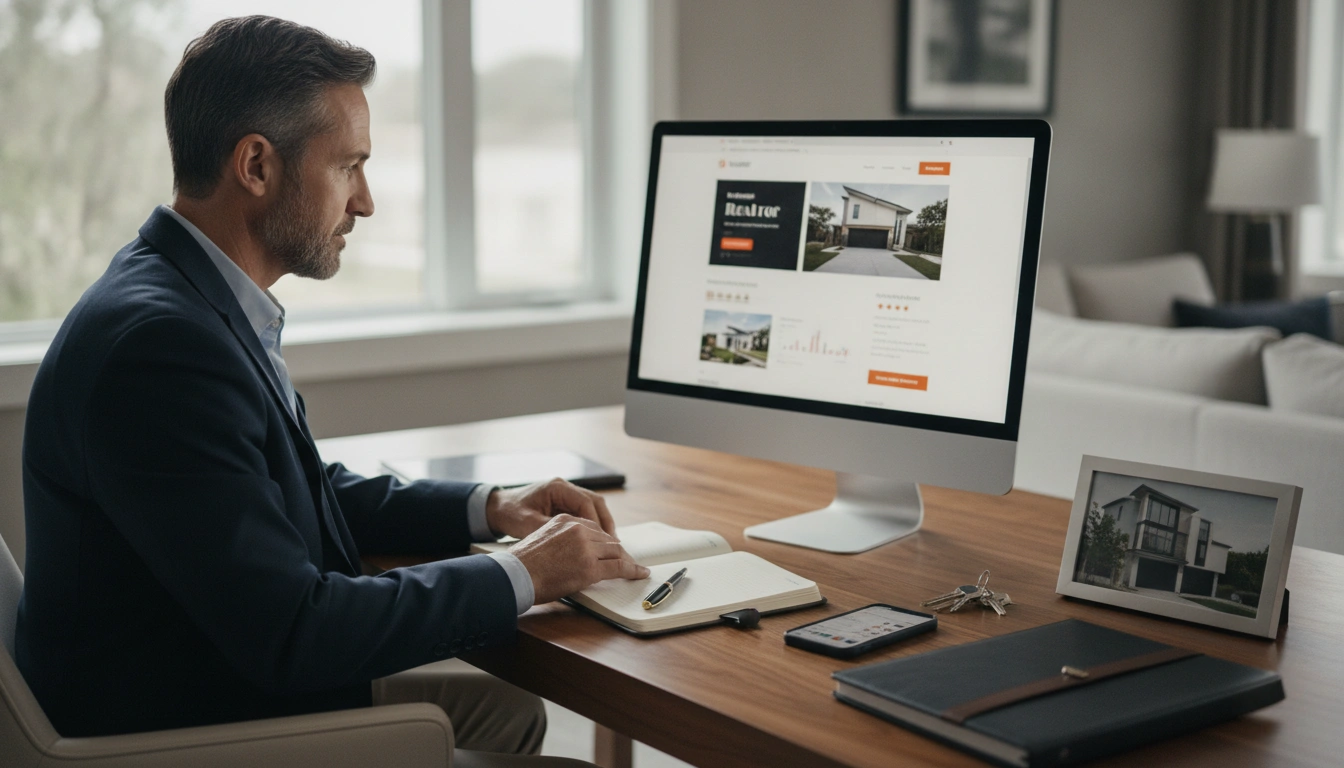
Not every lead is the same.
Some prospects are serious. Some are not.
Some respect your expertise. Some only want the cheapest option.
Some are ready to have a real conversation. Some are just browsing.
Some already trust you before the first call because your online presence made you look credible, professional, and prepared.
That is where your website matters.
A strong Realtor website should not only help people find you.
It should help the right people trust you.
Higher-quality clients usually do more research before they reach out. Sellers with strong equity, move-up buyers, relocation clients, luxury homeowners, investors, downsizers, and referral-based prospects often want to know who they are dealing with before they call.
They may check your website.
They may read your reviews.
They may look at your Google Business Profile.
They may compare you with another agent.
They may scan your bio, seller page, buyer page, local content, and social proof.
Your website can either raise your perceived value or make you look like every other agent.
That matters.
If your website looks generic, outdated, thin, or unclear, higher-quality prospects may not feel confident taking the next step.
If your website clearly communicates your expertise, process, market knowledge, reviews, and professionalism, it can help you attract better conversations.
The goal is not to appeal to everyone.
The goal is to look like the right choice for the clients you actually want.
Higher-Quality Clients Look for More Than a License
A real estate license does not make you stand out.
It only makes you eligible.
Higher-quality clients are usually looking for more than someone who can open doors, write offers, or put a home on the MLS.
They want someone who feels prepared, strategic, trustworthy, and easy to communicate with.
A serious seller may want to know:
- Can this agent price my home correctly?
- Do they understand my neighborhood?
- Will they present my home well?
- Do they have a clear process?
- Are they strong with communication?
- Do other sellers trust them?
- Do they look professional enough to represent my property?
A serious buyer may want to know:
- Does this agent understand the market?
- Can they help me make smart decisions?
- Will they explain the process clearly?
- Do they know the neighborhoods I care about?
- Can they guide me through offers, inspections, and timelines?
- Do they seem like someone I can trust?
Your website should help answer those questions before the first call.
If it does not, the prospect may assume your service is generic.
Higher-quality clients are not just looking for availability.
They are looking for confidence.
For more on building trust before the first conversation, read: Why Some Agents Look Premium Before the First Call Even Happens
Your Website Should Filter, Not Just Attract
Many agents think the purpose of a website is to get as many leads as possible.
That is not always the best goal.
A serious agent does not need more random inquiries.
They need better-fit prospects.
Your website should help filter people by showing what kind of clients you serve, what markets you focus on, what your process looks like, and what level of professionalism people can expect.
A strong website helps the right prospects think:
“This agent understands what I need.”
It also helps the wrong prospects realize:
“This may not be the cheapest or most casual option.”
That is not a bad thing.
A premium online presence should create alignment.
If you are a listing-focused agent, your website should make sellers feel like you have a plan.
If you serve luxury clients, your website should feel polished and detail-oriented.
If you work with relocation buyers, your website should show local guidance and step-by-step support.
If you help downsizers, your website should communicate patience, clarity, and trust.
Your website should not be vague enough for everyone.
It should be clear enough for the right clients.
For more on making your positioning clear, read: How to Make Your Online Presence Match Your Real-Life Reputation
Positioning Helps You Attract Better Clients
Higher-quality clients are usually attracted to clarity.
They want to know what you do, who you help, where you work, and why they should trust you.
That starts with positioning.
Positioning is the difference between sounding like every other agent and sounding like a clear choice.
A generic website message might say:
“Helping buyers and sellers achieve their real estate goals.”
That does not say enough.
A stronger message might say:
“Helping homeowners in [City] prepare, price, and sell with a clear strategy from listing to closing.”
Or:
“Guiding relocating families through [Market] with local insight and step-by-step support.”
Or:
“A listing-focused Realtor helping move-up sellers in [City] sell with confidence.”
These messages are more specific.
They tell prospects who the agent helps, where they work, and what kind of value they bring.
When your positioning is clear, higher-quality clients can self-identify.
They can see whether your service fits their situation.
That builds confidence.
It also makes your website feel more premium because it is not trying to be everything to everyone.
Strong positioning helps you attract clients who value what you actually do.
A Premium Website Builds Perceived Value
Higher-quality clients are influenced by presentation.
They may not explain it that way, but they notice.
They notice whether your website feels current.
They notice whether your design feels polished.
They notice whether your photos look professional.
They notice whether your messaging is clear.
They notice whether your reviews are visible.
They notice whether your brand feels consistent.
That impression affects perceived value.
A premium website does not mean flashy.
It means credible, intentional, clean, and aligned with the kind of clients you want to attract.
A premium Realtor website should feel:
- Professional: The design should support trust, not distract from it.
- Current: Outdated visuals can make even experienced agents look behind.
- Clear: Prospects should quickly understand who you help and where you work.
- Proof-driven: Reviews, testimonials, and credibility signals should be easy to find.
- Market-appropriate: A luxury coastal agent and a family-focused suburban agent may need different brand direction.
- Easy to use: The website should work well on mobile and make contact simple.
This is especially important for listing agents.
If sellers are trusting you with the presentation of their home, your own presentation should feel strong.
A weak website can make a strong agent look average.
A strong website can help your real-world professionalism show up online.
For more on why weak online presence creates doubt, read: Signs Your Online Presence Is Costing You Listings
Your Homepage Should Speak to the Client You Want
Your homepage is often the first full impression a prospect gets.
It should not waste that moment.
If you want higher-quality clients, your homepage should speak directly to the kind of people you want to work with.
That does not mean you should sound exclusive or cold.
It means you should be specific.
A strong homepage should answer:
- Who do you help?
- Where do you work?
- What kind of service do you provide?
- Why should someone trust you?
- What should they do next?
For example, a seller-focused homepage might say:
“Strategic real estate guidance for homeowners selling in [City].”
A relocation-focused homepage might say:
“Helping relocating families move into [Market] with local clarity and step-by-step guidance.”
A luxury-focused homepage might say:
“Refined real estate representation for distinctive homes in [Market].”
A downsizer-focused homepage might say:
“Helping homeowners simplify their next move with clear guidance, trusted strategy, and local expertise.”
The homepage should set expectations.
It should help higher-quality prospects feel like they are in the right place.
It should also include review highlights, local market signals, a strong About preview, seller and buyer pathways, and clear calls to action.
The homepage is not just a welcome page.
It is a positioning tool.
Your Service Pages Should Show Your Process
Higher-quality clients usually care about process.
They want to know how you work.
They want to know what happens if they hire you.
They want to know whether you have a plan.
That is why your seller and buyer pages matter.
A weak service page says:
“I help buyers and sellers with expert guidance.”
A stronger service page explains what that guidance actually looks like.
For sellers, your page should explain:
- Initial consultation
- Home preparation
- Pricing strategy
- Market analysis
- Professional presentation
- Launch plan
- Marketing strategy
- Showing feedback
- Offer review
- Negotiation
- Closing support
For buyers, your page should explain:
- Initial consultation
- Budget and financing coordination
- Market education
- Neighborhood guidance
- Home search strategy
- Offer preparation
- Negotiation
- Inspection support
- Closing guidance
When your process is visible, your service feels more valuable.
A prospect can see that they are not just hiring a person.
They are hiring a structured experience.
This is what helps higher-quality clients feel safer.
For more on seller-specific conversion, read: Why Some Agents Look Premium Before the First Call Even Happens
Reviews Help Better Clients Feel Safer
Higher-quality clients usually want proof.
They want to know that other people have trusted you and had a strong experience.
That is where reviews matter.
Reviews help turn your service from a claim into evidence.
A basic review helps.
A specific review helps more.
A vague review might say:
“Great agent. Highly recommend.”
A stronger seller review might say:
“She helped us prepare our home, price it strategically, manage buyer feedback, compare multiple offers, and feel confident through closing.”
A stronger buyer review might say:
“He helped us understand the market, compare neighborhoods, evaluate homes carefully, and write an offer we felt confident about.”
Specific reviews show the kind of value you provide.
They also attract prospects who care about that value.
Your reviews should be visible on:
- Homepage
- Seller page
- Buyer page
- Reviews page
- Google Business Profile
- Follow-up emails
- Listing materials
- Home valuation page
If your reviews are strong but hidden, they are not helping enough.
For more on review strategy, read: Why Google Reviews Matter for Real Estate Agents
Google Presence Supports Higher-Quality Conversations
Higher-quality clients often research before they call.
That means your Google presence matters.
When someone searches your name, they may see your Google Business Profile, reviews, website, photos, business description, service areas, and other profiles.
That search experience can either build confidence or create doubt.
A complete Google Business Profile can make you look:
- Active
- Professional
- Trusted
- Easy to contact
- Locally relevant
- Established
A thin Google profile can make you look less credible than you are.
This matters because better prospects often compare options.
They may search your name and another agent’s name.
If the other agent has a stronger Google presence, they may feel safer.
Your Google profile should support your website.
Google creates the first impression.
Your website deepens the trust.
Make sure your profile includes correct contact information, website link, service areas, business category, professional photos, business description, and visible reviews.
For more on this, read: Google Business Profile for Realtors: Why It Is Your First Impression
Local Content Attracts Clients Who Value Expertise
Better clients usually care about local knowledge.
They want an agent who understands the market, not just someone who has access to listings.
Local content helps show that expertise.
This may include:
- Community pages
- Neighborhood guides
- Market updates
- Seller guides by city
- Buyer resources by area
- Relocation guides
- Local FAQs
- Property-type content
- Blog posts about local trends
A community page should do more than show listings.
It should help prospects understand the area, lifestyle, housing styles, buyer demand, seller considerations, and what makes that market unique.
Local content helps higher-quality prospects feel like you know the market they care about.
It also helps search engines and AI tools understand where you are relevant.
There is no guaranteed way to force Google or AI tools to recommend you, but clear local content gives them more useful information about your service areas and expertise.
For more on local search, read: Best Realtor Near Me: Local SEO for Real Estate Agents
Your Brand Should Match the Level of Client You Want
If you want premium clients, your brand needs to support that perception.
That does not mean every brand needs to look luxury.
It means your brand should match the level of professionalism, trust, and service you provide.
Your brand includes:
- Website design
- Logo or wordmark
- Typography
- Color palette
- Headshot
- Photography
- Email signature
- Social media banners
- Buyer and seller guides
- Listing materials
- Overall tone
A strong brand can help prospects think:
“This agent looks established.”
“This agent seems professional.”
“This agent takes presentation seriously.”
“This agent is worth a conversation.”
A weak brand can create the opposite impression.
This matters because higher-quality clients are often more selective.
They want to feel like they are hiring someone who takes the details seriously.
Your brand should not make you look like a beginner if you are not one.
Your online presence should match your real-world reputation.
For more on personal branding, read: Personal Brand for Realtors: Why Looking Successful Online Matters
Your Website Can Educate Clients Before the Call
Higher-quality clients usually appreciate clarity.
They want to understand the process, options, risks, and next steps.
Your website can help educate them before they reach out.
That does not mean giving away everything.
It means helping prospects feel more informed and confident.
Useful educational content can include:
- “What Sellers Should Know Before Listing”
- “How to Prepare Your Home for the Market”
- “How Pricing Strategy Affects Buyer Demand”
- “What Buyers Should Know Before Making an Offer”
- “How to Choose the Right Neighborhood”
- “What Happens During a Listing Consultation”
- “How to Compare Offers Beyond Price”
This content shows how you think.
It turns your expertise into visible proof.
It also helps attract clients who value guidance, not just availability.
If you are already explaining these things on calls, they should exist on your website.
Your best conversations should become content.
For more on turning your listing talk into content, read: The Difference Between Looking Busy and Looking Trustworthy Online
Clear CTAs Help Serious Prospects Take the Next Step
Higher-quality clients are often more intentional.
They may not want a generic “Contact Me” button.
They want the next step to feel relevant.
Your website should include calls to action that match the client’s mindset.
For sellers:
- Request a home valuation
- Book a seller strategy call
- Schedule a listing consultation
- Get a custom market review
- Discuss your selling timeline
For buyers:
- Schedule a buyer consultation
- Start your home search
- Ask about homes in a specific area
- Get local market guidance
- Plan your next move
A clear CTA helps turn trust into action.
If your website makes people believe in your value but does not guide them toward the next step, you may still lose the opportunity.
Higher-quality clients should feel like reaching out is easy, natural, and worthwhile.
Consistency Makes You Look More Established
Your website is the trust hub, but it is not the only place prospects check.
They may also look at your Google Business Profile, Zillow, Realtor.com, brokerage page, LinkedIn, Instagram, Facebook, YouTube, and local directories.
If those platforms feel disconnected, trust weakens.
Your profiles should align around:
- Name
- Headshot
- Brokerage
- Website link
- Phone number
- Service areas
- Bio
- Reviews
- Brand style
- Positioning
- Contact information
Consistency makes you look more established.
Scattered profiles make you look less organized.
Higher-quality clients are often looking for signs of professionalism.
A consistent online presence helps create that feeling before the first call.
AI Search May Influence Premium Client Discovery
AI search is becoming another way people research local experts.
A prospect may ask ChatGPT, Gemini, Perplexity, or Google AI questions like:
- “Who are trusted Realtors in [City]?”
- “What can you tell me about [Agent Name]?”
- “Which agents specialize in selling homes in [Market]?”
- “Who has strong reviews near me?”
- “Who should I talk to before selling my home?”
No one can guarantee that AI tools will recommend a specific agent.
But AI tools rely on public information to understand who you are.
A clear website, strong reviews, local content, Google Business Profile, service pages, and consistent profiles can make your credibility easier to find and understand.
AI visibility is not about tricks.
It is about clarity.
If your online presence is thin or scattered, there may not be enough clear information about you.
If your online presence is structured and credible, search and AI tools have more useful context.
For more on this, read: AI Visibility for Realtors
Website Checklist for Winning Higher-Quality Clients
Use this checklist to see whether your website is helping attract better-fit prospects.
Positioning
- Homepage clearly states who you help
- Market focus is obvious
- Messaging is specific
- Client type is clear
- Value is easy to understand
Trust
- Reviews are visible
- Google Business Profile is linked
- About page builds credibility
- Bio explains your experience and approach
- Testimonials support your service
Premium Perception
- Website looks current
- Brand feels polished
- Headshot is professional
- Design matches your market
- Mobile experience is smooth
Service Clarity
- Seller page explains your process
- Buyer page explains your approach
- Local pages support expertise
- CTAs are clear and relevant
- Contact path is simple
Client Fit
- Content speaks to serious prospects
- Website filters unqualified leads
- Service expectations are clear
- Your process feels structured
- Your value is visible before the call
Search and AI Signals
- Service areas are clear
- Local content exists
- Reviews are easy to find
- Profiles are consistent
- Website explains who you are and what you do
If several of these are missing, your website may not be helping you attract the quality of clients you want.
Common Website Mistakes That Attract Lower-Quality Leads
Many agents unintentionally attract weak-fit prospects because their website does not communicate enough value.
Here are common mistakes.
Sounding Too Generic
If your website sounds like every other agent, prospects may compare you only on availability or price.
Hiding Your Process
Higher-quality clients want to know how you work.
Show them.
Not Showing Reviews
Proof attracts trust.
Trust attracts better conversations.
Having Weak CTAs
Generic CTAs create generic inquiries.
Specific CTAs attract more intentional prospects.
Looking Outdated
An outdated website can make a premium agent look average.
Having No Local Content
Better clients often care about market expertise.
Show your local relevance.
Relying Only on IDX
Property search is useful, but it does not position you as the expert.
Not Explaining Your Value
If prospects cannot understand your value, they may treat you like a commodity.
FAQ: Using Your Website to Win Higher-Quality Clients
How can Realtors use their website to attract better clients?
Realtors can attract better clients by making their website clear, credible, specific, and proof-driven.
The website should show who they help, where they work, what their process looks like, why clients trust them, and how prospects can take the next step.
What makes a Realtor website feel premium?
A premium Realtor website feels professional, current, intentional, easy to use, and aligned with the agent’s market and service level.
It should include strong branding, clear messaging, visible reviews, local content, and a simple contact path.
Can a website help filter low-quality leads?
Yes. A website can help filter low-quality leads by clearly communicating the agent’s positioning, process, service expectations, market focus, and value.
When the website is specific, it attracts better-fit prospects and discourages people who are not aligned.
Why do higher-quality clients research Realtors online?
Higher-quality clients often research Realtors online because they want confidence before reaching out.
They may check the website, Google Business Profile, reviews, bio, local content, and branding to decide whether the agent feels trustworthy.
Is social media enough to attract premium real estate clients?
No. Social media can support visibility, but it should not replace a strong website, Google presence, reviews, local content, and consistent brand identity.
Your website should be the trust hub for serious prospects.
Better Clients Need a Better First Impression
Higher-quality clients are not just looking for any agent.
They are looking for the right agent.
They want confidence.
They want proof.
They want clarity.
They want to know that you understand their market, their goals, and the size of the decision they are about to make.
Your website can help create that confidence before the first call.
It can position you clearly.
It can make your reviews visible.
It can explain your process.
It can show your local expertise.
It can make your brand feel more professional.
It can help serious prospects feel like you are worth contacting.
That is the real value of a strong Realtor website.
It does not just attract more clicks.
It helps attract better conversations.
Because great agents should not look average online.
And premium clients should not have to guess why you are worth calling.
Attract Better Clients With a Stronger Online Presence
Want to know whether your website is attracting the right prospects or making you look too generic?
Book a complimentary Online Presence Audit with LynkMe.
LynkMe reviews your website, Google Business Profile, reviews, branding, AI visibility signals, profile consistency, and overall online credibility so you can see where your presence is helping you attract higher-quality clients, where it may be weakening trust, and what needs to be fixed.
Your next premium client may research you before calling.
Make sure what they find builds trust.