
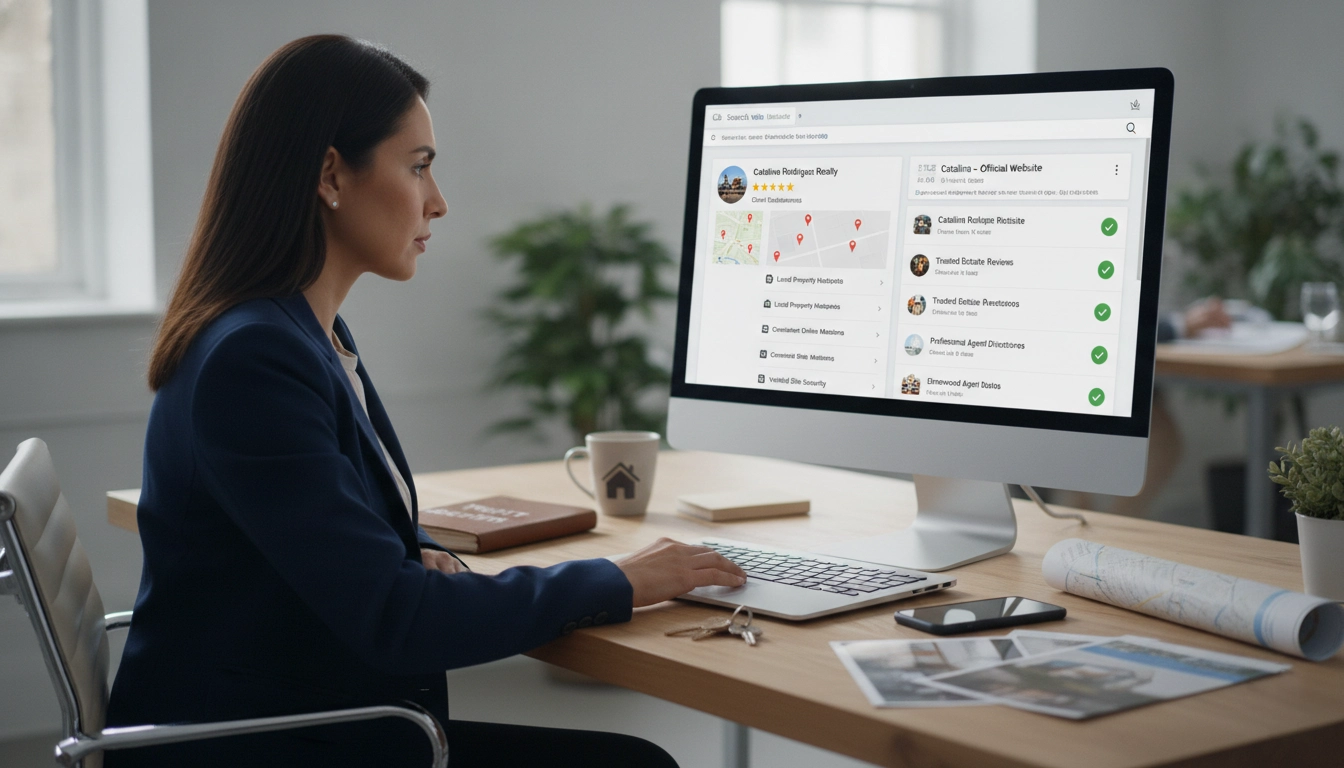
Google does not trust real estate agents because they say they are the best.
Google does not trust agents because they have a nice logo.
Google does not trust agents because they post a few generic blogs or add city names to every page.
Google looks for signals.
Those signals help Google understand who you are, where you work, what you do, and whether your online presence looks credible enough to show to people searching for real estate help.
That is why some agents seem to show up more consistently than others.
They have stronger signals.
Their Google Business Profile is complete.
Their reviews are stronger.
Their website is clearer.
Their content is more useful.
Their service areas are obvious.
Their online profiles are consistent.
Their brand looks active and trustworthy.
Their local authority is easier to understand.
This does not mean Google personally “likes” one agent more than another.
It means some agents make it easier for Google to understand and verify their credibility.
That is the core idea.
If you want better visibility, you need more than a website.
You need a credible online presence that supports trust from multiple angles.
Google Trust Is Really About Credibility Signals
When Realtors talk about “Google trust,” they often imagine a hidden score.
That is not the best way to think about it.
A better way is to think in terms of credibility signals.
Google has to decide which results are most useful for a search.
If someone searches “Realtor in [City],” “listing agent near me,” or “[Agent Name] reviews,” Google is trying to show results that are relevant, reliable, and helpful.
For Realtors, credibility signals may include:
- Complete Google Business Profile
- Strong Google reviews
- Recent review activity
- Useful website content
- Clear service areas
- Consistent contact information
- Local pages
- Relevant backlinks or mentions
- Updated third-party profiles
- Mobile-friendly website
- Clear page titles and headings
- Professional brand presence
- Helpful FAQs
- Searcher engagement signals
No single signal does everything.
A Realtor with strong reviews but a weak website may still have gaps.
A Realtor with a nice website but no reviews may still create doubt.
A Realtor with local content but inconsistent contact information may confuse both users and search systems.
The strongest online presence connects the pieces.
Google’s people-first content guidance emphasizes creating helpful, reliable content for users rather than content made mainly to manipulate search rankings .
For Realtors, that means trust is not built by keyword tricks.
It is built by making your real expertise visible online.
Google Needs to Understand Who You Are
One reason some agents appear more trustworthy online is simple:
Google can understand them better.
Their website and profiles clearly show:
- Full name
- Brokerage affiliation, when appropriate
- Service areas
- Buyer and seller services
- Local market focus
- Reviews
- Website
- Contact information
- Professional background
- Areas of expertise
A weak online presence creates confusion.
For example:
Your website says one phone number.
Your Google profile says another.
Your Zillow profile has an old brokerage.
Your brokerage profile has an outdated headshot.
Your social bio does not mention your market.
Your website does not clearly say where you work.
Your reviews are spread out and hard to find.
That scattered footprint makes you harder to understand.
A strong online presence creates clarity.
The same name appears everywhere.
The same market is mentioned everywhere.
The same website is linked everywhere.
The same phone number is used everywhere.
The same brand message is reinforced everywhere.
That consistency helps people.
It also helps search engines.
If Google cannot clearly understand who you are and where you are relevant, it has less reason to confidently show you.
Google Looks for Local Relevance
Real estate is local.
So local relevance matters.
An agent who clearly demonstrates connection to a specific city, neighborhood, or region has a stronger local foundation than an agent who vaguely says, “serving the greater area.”
Your local relevance can show up through:
- Google Business Profile service areas
- Website city pages
- Neighborhood pages
- Local seller guides
- Local buyer guides
- Reviews mentioning local areas
- Local backlinks or mentions
- Brokerage location
- Community involvement
- Market-specific content
- Consistent profile information
A strong local SEO presence makes your market obvious.
For example, instead of only saying:
“I help buyers and sellers with all their real estate needs.”
A stronger website might say:
“I help homeowners in Franklin prepare, price, and sell with confidence.”
That tells Google and people more.
It connects the agent to a service, audience, and market.
Local relevance should be specific, but honest.
Do not list every city within driving distance just to look bigger.
Do not create dozens of thin location pages where only the city name changes.
Build useful market pages around the places you actually serve.
For more on this, read: Local SEO for Real Estate Agents and AI Referral Visibility
Reviews Help Google and Clients See Real-World Trust
Google reviews matter because they are public trust signals.
They show that real clients have worked with you and taken time to share feedback.
A strong review profile can support both visibility and conversion.
Reviews help answer questions like:
- Is this agent active?
- Do people trust them?
- Do they help buyers, sellers, or both?
- Are clients satisfied?
- Do reviews mention local markets?
- Are reviews recent?
- Does the agent respond professionally?
A review that says:
“Great agent. Highly recommend.”
is helpful.
But a specific review is stronger.
For example:
“She helped us sell our home in Brentwood. She explained pricing clearly, helped us prepare the property, managed multiple offers, and kept us informed through every step.”
That review creates stronger trust because it gives context.
It shows:
- Location
- Service type
- Process
- Communication
- Seller experience
- Client confidence
Google reviews alone do not guarantee rankings.
But they help build the credibility picture around your name.
They also matter deeply to prospects.
A seller may choose to call the agent with a stronger review profile because that agent feels safer.
For more on this, read: Why Google Reviews Matter for Real Estate Agents
Google Business Profile Completeness Matters
Your Google Business Profile is one of your most important trust assets.
A complete profile gives Google and prospects structured information about your business.
A weak profile creates uncertainty.
A strong Realtor Google Business Profile should include:
- Correct name
- Accurate phone number
- Website link
- Professional photos
- Clear service areas
- Relevant category
- Strong business description
- Google reviews
- Review responses
- Current brokerage information, when appropriate
If your profile is incomplete, outdated, or inconsistent, it can hurt trust.
Think of your Google Business Profile as your local credibility card.
When someone searches your name or local real estate services, your profile may appear before they visit your website.
That means it needs to look current and professional.
A profile with strong reviews, current photos, accurate information, and a clear website link gives people more confidence.
A profile with few reviews, no photos, outdated information, or no website link creates friction.
Google trust starts with clarity.
Your Google Business Profile is one of the clearest places to build it.
For more, read: Google Business Profile for Realtors: Why It Is Your First Impression
Your Website Shows Depth Beyond a Profile
A Google Business Profile can show quick trust signals.
But your website shows depth.
Your website is where Google and prospects can better understand your services, market, content, and authority.
A strong Realtor website should include:
- Clear homepage
- About page
- Seller page
- Buyer page
- City or neighborhood pages
- Reviews page
- Contact page
- Blog or resource section
- Local FAQs
- Clear calls to action
A weak website may technically exist, but still fail to build authority.
Common problems include:
- Generic homepage
- No seller page
- No buyer page
- No local pages
- Thin content
- Hidden reviews
- Poor mobile experience
- Slow loading
- Weak page titles
- No clear calls to action
- No internal links
- Outdated branding
Google needs useful content to understand what you should be relevant for.
Clients need useful content to trust you.
A website that only says “contact me for all your real estate needs” does not give either side enough information.
A strong website explains your real expertise.
For more, read: Realtor Website Credibility Checklist
Helpful Content Builds Authority Over Time
Authority is not built by one blog post.
It is built by a clear body of useful content connected to your market and services.
For Realtors, helpful content might include:
- Selling a home in [City]
- Buying a home in [Neighborhood]
- Moving to [City]
- How to choose a listing agent in [Market]
- What sellers should know before listing in [Neighborhood]
- Local relocation guide
- Downsizing guide for [City]
- Luxury seller guide for [Market]
- Google reviews guide for Realtors
- Realtor website credibility checklist
The best content answers real questions.
It should help clients understand something important before they hire you.
Weak content sounds generic:
“Buying a home is exciting. Contact a Realtor to help you.”
Strong content is specific:
“If you are buying in [Neighborhood], pay attention to commute routes, school zoning, older home maintenance, flood zones, and how quickly well-priced homes move.”
Specific content builds authority because it shows real knowledge.
Do not publish content just to have content.
Publish content that helps your ideal clients make better decisions.
That is what Google’s helpful content guidance points toward: content created for users first, not content created mainly to manipulate rankings .
Consistency Across Profiles Reinforces Trust
Google sees information about you across many places.
Your website is one source.
Your Google Business Profile is another.
Your brokerage profile, Zillow profile, Realtor.com profile, LinkedIn, Facebook, Instagram, and other directories may also contribute to your online footprint.
If those profiles are inconsistent, trust weakens.
Check consistency across:
- Name
- Phone number
- Website link
- Brokerage
- Headshot
- Service areas
- Bio
- Brand message
- Social links
Inconsistency creates confusion.
If your Google profile links to one website, your Zillow profile links to another, your brokerage profile shows an old phone number, and your social bio mentions a different market, the overall impression feels messy.
A consistent footprint makes you easier to verify.
It also makes you look more established.
Google trust is not only about what is on your website.
It is about whether your online presence makes sense everywhere.
Authority Also Comes From Third-Party Signals
Google may also look at signals beyond your own website.
For Realtors, third-party signals may include:
- Brokerage profile
- Zillow profile
- Realtor.com profile
- Local business directories
- Local news mentions
- Community organization pages
- Podcast appearances
- Sponsorship pages
- Chamber of commerce listings
- Professional associations
- Local backlinks
- Reviews on multiple platforms
Not every agent needs every type of mention.
But relevant third-party signals can help reinforce that you are a real, active, locally connected professional.
A local mention from a trusted community organization may support credibility.
A spammy backlink from an irrelevant website does not help your brand.
Quality matters.
Relevance matters.
Do not chase low-quality backlinks.
Build real local authority.
Technical Quality Supports Trust
Technical SEO is not the exciting part, but it matters.
A slow, broken, insecure, or confusing website can hurt both user experience and search visibility.
Your website should have:
- SSL security
- Fast loading pages
- Mobile-friendly design
- Clean navigation
- Clear page titles
- Proper headings
- Working forms
- No broken links
- Optimized images
- Clean URLs
- Search Console setup
- Analytics tracking
- Sitemap
- Basic schema, where appropriate
Technical SEO does not replace good content.
But technical issues can limit good content.
If your website is hard to crawl, slow to load, or frustrating to use, it can weaken trust.
A technically clean site tells users and search engines that your online presence is maintained.
That matters.
Google Trust Is Not Built by Keyword Stuffing
Some agents still think SEO means repeating keywords over and over.
That is outdated.
Keyword stuffing makes content harder to read.
It can also make your website feel less trustworthy.
Bad example:
“If you need a Franklin Realtor, our Franklin Realtor services help Franklin Realtor clients buy and sell Franklin real estate.”
That does not sound professional.
A better approach:
“I help Franklin homeowners prepare, price, and sell with a clear strategy based on local market conditions, buyer demand, and the goals of the move.”
That is clearer.
It uses natural language.
It speaks to people.
Google has become better at understanding topics, context, and usefulness. Your content should be clear and specific, not repetitive and robotic.
Use keywords naturally.
Write for real clients.
Google Trust Is Not Built Overnight
Authority takes time.
A strong Google presence is built through consistent signals, not one quick fix.
You build trust by:
- Keeping your Google Business Profile updated
- Asking for honest reviews consistently
- Responding to reviews
- Publishing useful local content
- Updating your website
- Improving page structure
- Creating service pages
- Cleaning up online profiles
- Building local mentions
- Keeping contact information consistent
- Improving mobile experience
- Making your brand clearer
These are not one-time tasks.
They are part of maintaining a serious online presence.
Agents who do this consistently often look stronger online than agents who only update their website every few years.
Google trust follows consistency.
So does client trust.
Why Some Strong Agents Still Look Weak to Google
Some excellent agents have weak online visibility.
Not because they are bad at real estate.
Because their credibility is not visible online.
They may have:
- Few Google reviews
- Outdated website
- Incomplete Google Business Profile
- No local content
- Generic brokerage profile
- Inconsistent phone numbers
- Weak service area signals
- No seller or buyer pages
- No review strategy
- No internal linking
- No clear brand positioning
In person, they may be excellent.
Online, they look average.
That gap can cost trust.
A seller who has not met you yet can only judge what they see.
If your online presence does not show your authority, Google and clients may have less reason to view you as a strong local option.
Great agents should not have invisible credibility.
What Google May Trust More
Google may have more confidence in agents whose online presence is clear, complete, and consistent.
That usually means:
- Strong personal website
- Complete Google Business Profile
- Recent reviews
- Specific reviews
- Clear service areas
- Helpful local content
- Consistent profiles
- Professional branding
- Local mentions
- Good technical site health
- Clear name search results
- Useful service pages
Again, this does not guarantee rankings.
No one can promise that.
But these signals create a stronger foundation.
Google is more likely to understand you when you make your identity, authority, and local relevance clear.
Prospects are more likely to trust you for the same reason.
How AI Search Connects to Google Trust
AI search is becoming another way people research agents.
A client may ask ChatGPT, Gemini, Perplexity, Google AI, or another tool:
- “Who are the best Realtors in [City]?”
- “Which agents have strong reviews near me?”
- “What can you tell me about [Agent Name]?”
- “Who specializes in selling homes in [Neighborhood]?”
- “Is [Agent Name] a good Realtor?”
No one can guarantee that AI tools will recommend a specific agent.
But AI tools need clear public information to understand and describe people, businesses, and local expertise.
The same signals that support Google trust can also support AI visibility:
- Website clarity
- Reviews
- Google Business Profile
- Local content
- Consistent profiles
- Third-party mentions
- Strong about page
- Clear services
- Accurate contact information
AI visibility is not about gaming the system.
It is about making your real-world credibility easier to understand online.
For more on this, read: AI Visibility for Realtors
Realtor Authority Checklist
Use this checklist to see whether your online presence gives Google enough trust signals.
Google Business Profile
- Complete profile
- Accurate phone number
- Correct website link
- Current photos
- Clear service areas
- Strong business description
- Google reviews
- Review responses
Reviews
- Recent reviews
- Specific reviews
- Seller reviews
- Buyer reviews
- Local mentions
- Reviews displayed on website
- Ethical review process
Website
- Clear homepage
- Strong about page
- Seller page
- Buyer page
- Local pages
- Reviews page
- Contact page
- Mobile-friendly design
- Fast loading speed
Content
- Helpful local content
- Seller-focused pages
- Buyer-focused pages
- FAQs
- Internal links
- No thin duplicate pages
- No keyword stuffing
Profile Consistency
- Brokerage profile updated
- Zillow profile updated
- Realtor.com profile updated
- Social profiles consistent
- Contact details aligned
- Headshots current
- Website links correct
Local Authority
- Local mentions
- Community involvement online
- Relevant backlinks
- Market-specific content
- Reviews that mention service areas
- Clear local positioning
Technical SEO
- SSL security
- Clean URLs
- Working forms
- Proper headings
- Optimized images
- No broken links
- Sitemap
- Search Console
- Analytics
- Schema where appropriate
If many of these are missing, Google may not have enough clear signals to understand your authority.
Common Mistakes That Weaken Google Trust
Avoid these mistakes.
Relying Only on a Brokerage Profile
A brokerage profile is useful, but it usually does not give you enough control over content, local SEO, reviews, or calls to action.
Ignoring Google Reviews
Few, old, or vague reviews make trust harder.
Creating Generic Content
Generic content does not prove local expertise.
Using Inconsistent Contact Information
Conflicting information across profiles creates confusion.
Keyword Stuffing
Repetition does not equal relevance.
Hiding Reviews on Your Website
Proof should be visible where people make decisions.
Letting Profiles Go Outdated
Old headshots, old brokerage info, and broken links hurt credibility.
Neglecting Mobile Experience
A poor mobile website can push prospects away.
Making Unsupported Claims
Avoid “best Realtor” or “top agent” claims without proper support.
Treating SEO as a One-Time Project
Authority requires ongoing maintenance.
FAQ: Why Google Trusts Some Agents More Than Others
1. Why does Google show some Realtors more than others?
Google may show some Realtors more often because their online presence provides stronger signals of relevance, credibility, and local authority.
These signals can include a complete Google Business Profile, reviews, useful website content, clear service areas, consistent information, and local relevance.
2. Do Google reviews help Realtors build trust with Google?
Google reviews can support local credibility and user trust.
Reviews alone do not guarantee rankings, but strong, recent, specific reviews can make an agent’s Google presence more credible and help prospects feel more confident contacting them.
3. Does a Realtor need a personal website for Google trust?
A personal website is important because it gives Realtors more control over their brand, services, local content, reviews, and calls to action.
A brokerage profile can support credibility, but a personal website usually provides a stronger authority foundation.
4. What weakens a Realtor’s Google authority?
Common issues include incomplete Google Business Profile, few reviews, outdated website, generic content, inconsistent contact information, weak local pages, missing seller or buyer pages, and outdated online profiles.
These gaps can make the agent harder to understand and trust online.
5. Can Realtors guarantee better Google rankings?
No. Realtors cannot guarantee better Google rankings because rankings depend on many factors.
But agents can improve their foundation by strengthening their website, reviews, Google Business Profile, local content, profile consistency, and overall online credibility.
Final Takeaway: Google Trusts Clarity, Consistency, and Credibility
Google does not trust an agent just because the agent says they are great.
Google needs signals.
Clients need signals too.
A stronger online presence gives both of them more to work with.
Your website should clearly explain who you are.
Your Google Business Profile should look complete.
Your reviews should be visible and specific.
Your service areas should be clear.
Your content should be useful.
Your profiles should be consistent.
Your local authority should be easy to understand.
That is how trust gets built online.
Not through tricks.
Through clarity, consistency, and credibility.
Great agents should not be hard for Google or clients to understand.
See What Trust Signals Your Online Presence Is Missing
Not sure whether Google and clients have enough reason to trust your online presence?
Book a complimentary Online Presence Audit with LynkMe.
LynkMe reviews your website, Google Business Profile, reviews, local content, branding, AI visibility signals, and overall online credibility so you can see where you look strong, where you look weak, and what needs to be fixed.
Your next seller or referral may search you before calling.
Make sure what they find builds trust.